


Land Leveling After a Pool Build: Fixing Grade and Drainage in Fort Worth Yards
Land leveling after a pool build corrects the grade and drainage that pool construction disturbs. In Fort Worth and Colleyville yards, leftover excavation spoil, compacted equipment paths, and a raised pool deck commonly leave water trapped between the deck and the fence line or pushed back toward the house. The fix is to let the backfill zone settle for roughly 30 days, re-establish a fall of at least 6 inches over the first 10 feet away from the foundation, shape swales at about 1 to 2 percent toward a legal discharge point, and add channel drains, catch basins, or French drains only where grade alone cannot carry the water. Buzz Cutters Landscaping handles land leveling, grading, and drainage across Fort Worth, Colleyville, and the surrounding North Texas communities. Call 817-888-6535.
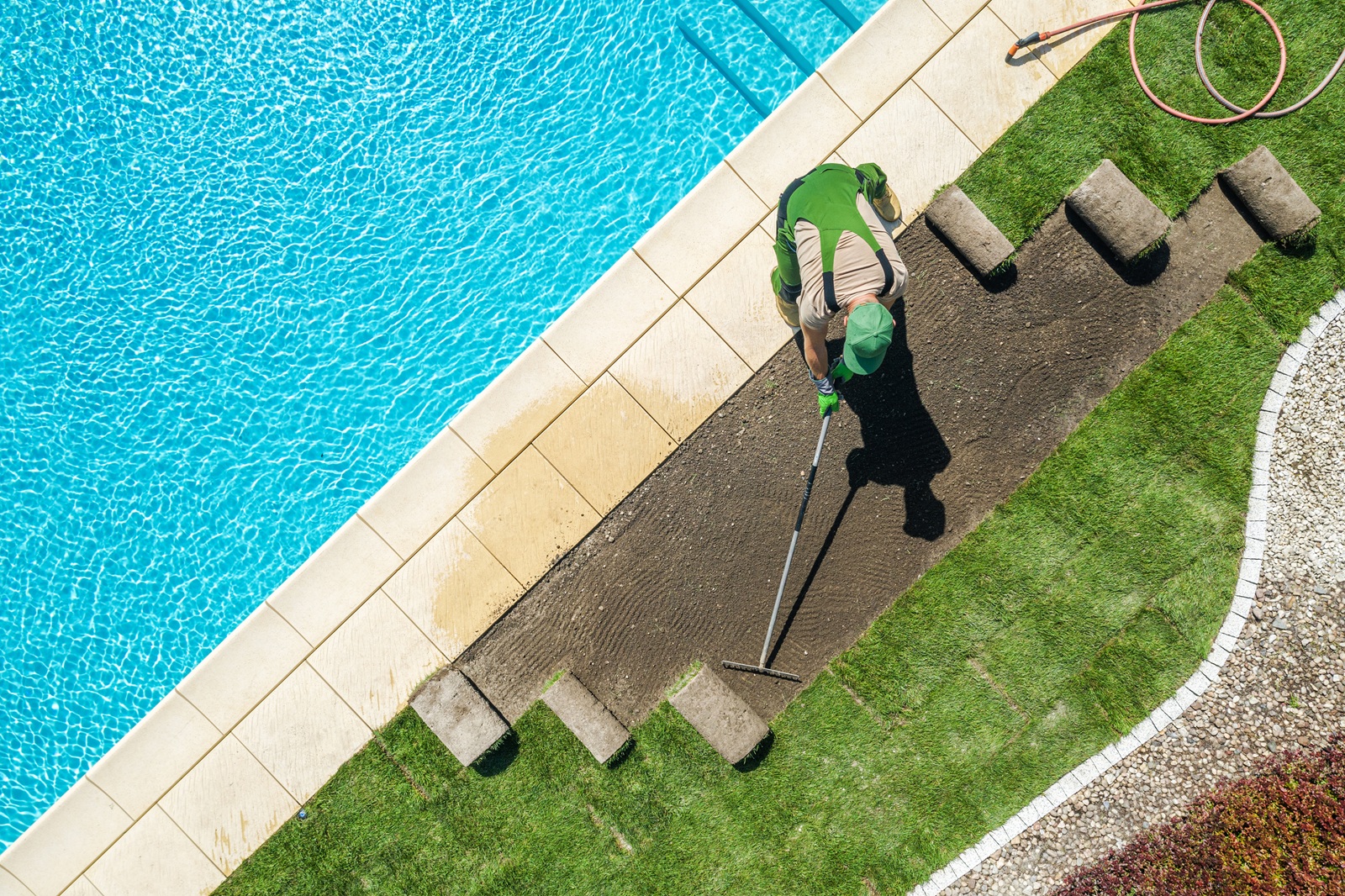
The pool is finished. The water is blue, the lights work, the equipment pad hums. Then the first real North Texas storm rolls through and half the backyard turns into a shallow pond that sits there for two days. Somewhere near the fence, the grass starts to yellow. Along the back of the house, a dark line of wet soil creeps against the slab.
This is one of the most common calls we take from homeowners in Fort Worth and Colleyville, and it almost never means the pool was built wrong. It means the yard around the pool was never finished. Pool construction is an excavation project, and excavation changes the elevation of everything it touches. Until somebody re-establishes the grade, the water has nowhere sensible to go. This guide covers why it happens, what the yard actually needs, how long to wait before correcting it, and how the work is done on North Texas clay.
Why Does a New Pool Leave the Yard Draining the Wrong Way?
Because a pool build ends at rough grade, not finished grade, and four separate things happen during construction that each move water the wrong direction.
1. The pool contract usually stops at rough grade
Read most residential pool agreements closely and site restoration is either excluded outright or defined as hauling off the large debris and knocking the dirt down roughly level. That is a reasonable scope for a pool builder. It is not a finished yard. The gap between “roughly level” and “drains correctly” is the work, and it is a different trade with different equipment.
2. Excavation spoil changes the surrounding elevation
A typical inground pool removes a substantial volume of soil. Hauling all of it away costs money, so some of it commonly gets spread across the yard. Even a few inches of spoil distributed over a lawn is enough to flatten a slope that used to carry water off the property, or to build a low ridge that stops it. In yards where the original builder grade was already close to the code minimum, that redistribution is all it takes to reverse the flow.
3. The deck and coping become a dam
A finished pool deck typically sits higher than the turf around it. When the deck is poured and the surrounding grade is left low, the deck edge acts as a wall. Rain that lands on the deck sheets off toward the yard, and rain that lands in the yard has nowhere to escape past the deck. The trapped zone between the deck and a fence line is where we find standing water most often, and it is the hardest area to correct after sod has been laid over it.
4. Equipment traffic compacts the access path
Excavators, gunite trucks, and material deliveries all use the same route into the backyard, usually the side yard. That strip gets compacted hard enough that water no longer infiltrates. A compacted access path running along the side of a house is effectively a shallow channel pointed at the foundation, and it does not fix itself.
How Does North Texas Clay Change What Happens After the Pool Is Finished?
Clay makes both the drainage problem and the settling problem worse, and it is why post-pool grading in Fort Worth is not the same job it would be in a sandy-soil market.
Much of Tarrant County sits on Blackland Prairie soils, including the Houston Black series that serves as the Texas state soil. These are Vertisols with a high smectite clay content, and the USDA Natural Resources Conservation Service documents their plasticity index in the range of 40 to 60. For reference, building codes classify a soil as expansive at a plasticity index of 15. North Texas clay routinely tests at two to four times that threshold.
Three consequences follow directly, and all of them land on a yard that has just been excavated:
- Water moves slowly through it. Once clay reaches saturation it stops accepting water, so anything ponding on the surface stays on the surface. A low spot in clay is not a temporary puddle, it is a two-day feature.
- It swells and shrinks with moisture. The same soil expands when wet and contracts when dry, opening cracks in summer that act as funnels for the next rain. Keeping perimeter moisture reasonably consistent matters more than keeping it low, and grade is the main tool for doing that.
- Backfill placed in clay settles for months. Disturbed clay dropped into the working space around a new pool shell does not reach a stable density on its own. It drops, and the finished grade drops with it, which is why timing the correction matters.
Layer the rainfall pattern on top of that. National Weather Service normals for the Dallas-Fort Worth area put annual precipitation at roughly 36 inches, concentrated in two peaks: May, which averages close to 4.9 inches, and October, near 4.2 inches. The yard does not get a gentle, even year. It gets long dry stretches that crack the clay open, punctuated by heavy spring and fall storms that arrive faster than saturated clay can absorb them. A grade that is merely adequate in a mild climate fails here.
We cover the soil side of this in more depth in our guide to drainage solutions for clay soil yards in Colleyville.
What Grade Does Your Yard Actually Need After a Pool Build?
The benchmark is a fall of at least 6 inches within the first 10 feet away from the foundation, with impervious surfaces in that same zone sloping at least 2 percent away from the house.
That target comes from Section R401.3 of the International Residential Code, which requires lots to be graded so surface water drains away from foundation walls, and surface drainage to be directed to an approved point of collection. Where lot lines, walls, or other physical barriers make that fall impossible, the code allows drains or swales instead, as long as water still moves away from the structure. That exception matters on tight Fort Worth lots where a pool deck now occupies much of the space that used to carry the slope.
Working targets we grade to on a post-pool correction:
Area | Target Fall | Why It Matters Here |
First 10 feet from the foundation | Minimum 6 inches, about 5 percent | Keeps storm runoff and irrigation off the slab perimeter, where clay movement does the most damage |
Pool deck, patio, and other impervious surfaces within 10 feet of the house | Minimum 2 percent away from the structure | Hard surfaces shed nearly all the water that lands on them, so direction is everything |
Open lawn beyond the first 10 feet | About 2 percent toward a swale or the lot line | Enough movement to keep sheet flow going without creating an erosion channel or a mowing hazard |
Shaped swale running to a discharge point | Roughly 1 to 2 percent along its length | Carries volume across long runs in flat backyards without scouring |
Deck-to-turf transition at the pool edge | Continuous fall away from coping, no trapped pocket | Prevents the standing-water band that forms between a raised deck and a fence |
Those are starting points, not a formula. The only number that ultimately matters is whether water leaves the property at a point where it is legally allowed to go, without being dumped onto a neighbor.
How Long Should You Wait Before Regrading After a Pool Build?
Plan on roughly 30 days of settling in the backfill zone before finished grading, and about six to eight weeks before any new concrete or paver work over that zone.
This is the step homeowners most often skip, usually because the yard looks terrible and the instinct is to fix it immediately. Grading fresh backfill produces a beautiful finished surface that then drops an inch or two over the next two months, undoing the work. Waiting is not a delay tactic, it is part of the method.
A reasonable sequence for a North Texas yard:
- Weeks 1 to 4: let the backfill ring around the pool shell settle. Keep irrigation off that zone so it settles under natural conditions rather than being artificially saturated. Water the rest of the yard normally.
- Week 4 onward: grade correction, swale shaping, compaction, and drainage installation. This is the point where elevations can be set and expected to hold.
- Weeks 6 to 8 onward: new hardscape over the disturbed zone, including patio extensions, walkways, and retaining structures.
- After grade is confirmed: sod, turf, planting beds, and irrigation adjustment. Never before.
We assess each site rather than working to a fixed calendar, because how the fill was placed and how much rain it has absorbed change the timeline considerably. A pool backfilled in a dry August behaves differently from one backfilled during a wet May.
What Are the Warning Signs That Your Post-Pool Grade Is Wrong?
Most of them show up within the first two or three significant rainfalls, and they are easy to read once you know what to look for.
- Standing water that lingers more than 24 hours after rain stops, particularly in the band between the pool deck and a fence or property line.
- A dark, persistently damp strip of soil along the back or side of the house that never fully dries out.
- Turf that yellows, thins, or dies in a defined patch rather than in scattered spots, which usually traces a low area or a compacted equipment path.
- Mud or silt washing onto the pool deck after storms, a sign that surrounding grade is draining toward the deck instead of away from it.
- Visible settlement rings or depressions in the ground following the outline of the pool shell.
- Erosion channels or exposed soil where concentrated flow has started cutting a path across the lawn.
- Sprinkler heads sitting too high, buried below grade, or spraying directly onto the new deck.
- Water pooling against a retaining wall or at the base of a raised bed installed during the pool project.
One of these on its own may be a small correction. Three or four together usually means the whole runout needs to be reshaped rather than patched.
How Is Land Leveling After a Pool Build Actually Done?
The work follows a fixed order, because each step depends on the one before it. Skipping the assessment and going straight to moving dirt is how yards end up regraded twice.
1. Site assessment and elevation mapping.
We walk the property, identify where water enters, where it stalls, and where it is legally able to leave. Elevations are shot at the foundation, the deck edges, the low points, and the discharge target so the correction is based on measurements rather than a visual read.
2. Utility and irrigation locating.
Pool construction routinely cuts irrigation lateral lines and leaves them buried. Before any earthwork, lines, valves, gas runs, and pool plumbing get located and marked so grading does not compound the damage.
3. Decompaction of equipment paths.
Shallow ruts are loosened. Deeper compacted zones need the surface cut out and the hardpan mechanically broken before new material goes in, or the fill simply sits on top of an impermeable layer.
4. Spoil removal or redistribution.
Excess excavated clay left on site gets hauled off or intentionally relocated to where additional elevation is useful. Dumping it into a low spot because the low spot is convenient is how drainage easements get filled and neighbors get flooded.
5. Rough grading and fill placement in layers.
Fill goes in in lifts and each lift is compacted before the next is added. In clay, this is the difference between a grade that holds for years and one that develops fresh low spots by the following spring.
6. Swale shaping and finish grading.
Swales are cut where sheet flow alone cannot carry the volume, then feathered so they read as part of the landscape rather than a trench. Finish grading sets the final surface against the deck, walkways, and bed edges.
7. Drainage installation where grade alone is not enough.
Channel drains, catch basins, French drains, and downspout extensions get installed only where the shaped grade cannot finish the job, and always with a defined outlet. A drain without a discharge plan just relocates the puddle.
8. Verification, then restoration.
Elevations are re-checked, and where possible the site is tested under flow before restoration. Then sod, turf, beds, and irrigation adjustments go in on a surface that has already proved it works.
Our full land leveling and grading service page covers the equipment and methods in more detail, and the drainage services page covers the systems referenced in step seven.
Standing water in the yard after your pool build?
Buzz Cutters corrects grade, installs drainage, and restores the landscape around new pools throughout Fort Worth, Colleyville, Southlake, Keller, and Grapevine. Call 817-888-6535 or request a free estimate to schedule a site evaluation.
Which Drainage Systems Pair With Post-Pool Land Leveling?
Grade does the heavy lifting; hardware closes the gaps grade cannot reach. On a typical Fort Worth or Colleyville backyard with a new pool, we are usually combining two or three of the following rather than relying on any single system.
Solution | What It Does | When It Fits a Post-Pool Yard |
Channel drain | Linear surface grate that intercepts sheet flow along a hard edge | Along the low edge of a pool deck or patio, catching runoff before it reaches turf |
Catch basin | Collection box with a grate, piped to an outlet | A trapped corner between the deck and a fence where grade alone cannot carry water out |
French drain | Perforated pipe in gravel that collects subsurface water | Persistently saturated zones and side yards compacted by construction traffic |
Dry creek bed | Shaped, stone-lined channel that carries surface volume | Long runs across flat backyards where a visible feature is preferable to a bare swale |
Downspout extension | Moves roof runoff well clear of the foundation | Roof water discharging into the same zone the pool build already disturbed |
Grade and slope correction | Reshapes the surface so water moves by gravity alone | The first thing to evaluate on nearly every post-pool yard, and often most of the fix |
Where the correction involves holding back elevation rather than moving water across it, a retaining wall may be the right tool, and any irrigation disturbed during the pool build is handled through our irrigation and sprinkler repair service.
What Local Rules Apply in Fort Worth and Colleyville?
Most residential backyard regrades sit below the city grading permit threshold, but several other rules still apply and they are the ones that create disputes.
- Grading permits. The City of Fort Worth grading permit applies to development activity disturbing more than one acre, or land that is part of a larger common plan of development exceeding one acre. A standard residential backyard correction falls under that threshold.
- Retaining walls. Fort Worth requires a permit for retaining walls over 4 feet measured from the bottom of the footing, with engineered plans, and the wall drainage must not redirect water onto a neighboring property.
- No diversion onto neighbors. This is the rule that generates the most conflict after pool projects. Solving your standing water by pushing it across a property line is not a solution, and it is not defensible.
- Drainage easements. Residential pool permits require a site plan showing utility and drainage easements. Filling or obstructing an easement or an established swale with excavation spoil creates problems for the whole block, not just one lot.
- Pool barriers and inspections. Fort Worth adopts the International Residential Code barrier requirements for residential pools, including minimum barrier height and self-closing, self-latching gates. Grading work that changes finished elevation at a fence line can affect barrier compliance, so it is worth checking before the work rather than after.
- HOA review. Many Colleyville and Southlake neighborhoods require architectural review for visible drainage features, dry creek beds, and walls. Confirm before installation.
Requirements change, and Colleyville administers its own permitting separately from Fort Worth. Confirm current requirements with the relevant city before work begins.
What Does This Look Like in a Fort Worth or Colleyville Backyard?
The pattern repeats across the area, but lot age and lot size change which version of the problem shows up.
In older established Fort Worth neighborhoods, lots tend to be narrower and the side yard is the only access route. Those yards come out of a pool build with a hard-compacted side strip running the length of the house and very little room to build slope into it. The correction usually leans on decompaction plus a French drain or shaped swale in that side yard, because there simply is not the width to develop 6 inches of fall by grading alone.
In Colleyville and the larger-lot neighborhoods through Southlake, Westlake, and Keller, the lots are wider and the pools are bigger, which means more excavated clay and more of it spread on site. The failure mode there is usually a flattened backyard where the original fall to the rear lot line has been erased, plus a substantial trapped zone behind the pool deck. Those corrections involve more earthwork and more often a dry creek bed or a combination of catch basins, because the distance to the discharge point is longer.
Both versions share the same underlying soil behavior, and both are solved the same way: measure, wait for settlement, reshape, compact, then restore.
Can You Correct Post-Pool Grade Yourself?
Some of it, yes. The parts that matter most, generally not.
Reasonable for a homeowner to handle:
- Extending downspouts so roof water discharges well clear of the disturbed zone.
- Core aerating compacted turf areas in spring and fall to improve infiltration over time.
- Clearing construction debris, gravel, and gunite overspray out of beds and lawn areas.
- Documenting where water stands, with photos and timestamps, after each rain. This is genuinely useful information for whoever does the correction.
Work that needs a contractor:
- Anything involving elevation across a runout. Correcting grade by eye in a flat backyard almost always produces a new low point somewhere else.
- Compaction in lifts. Without it, clay fill settles and the finished grade fails within a season.
- Any drain with a piped outlet, where the discharge point, pipe fall, and legal considerations all have to line up.
- Work near pool plumbing, bonding, electrical runs, or existing irrigation mains.
- Retaining structures of any height that will hold back soil under load.
Why Fort Worth and Colleyville Homeowners Call Buzz Cutters
Because correcting a yard after a pool build sits at the intersection of grading, drainage, irrigation, and landscape restoration, and it goes badly when those are treated as four separate jobs.
What You Get | What It Means for a Post-Pool Yard |
One crew across grading, drainage, irrigation, and restoration | No handoffs between trades, and nobody regrading over a drain somebody else installed last week |
North Texas clay experience | Settlement timing, compaction in lifts, and swale design built around Blackland Prairie soil behavior rather than generic guidance |
Measured elevations, not visual estimates | Grade targets set against the foundation, deck, and discharge point, then verified before restoration |
Full landscape capability | Sod, turf, planting, hardscape, and retaining structures handled in the same project once grade is confirmed |
Locally based in Colleyville | Office at 7131 Colleyville Blvd, Suite 102, Colleyville, TX 76034, serving Tarrant, Denton, and Collin County communities |
Free on-site estimate | A site evaluation before any commitment, including an honest read on whether the yard needs to settle longer first |
Once the grade is right, the rest of the yard can finally be built properly. That is the point where sod installation, artificial turf, hardscaping, and planting make sense. Our related guide on why proper land leveling comes before turf or sod covers that sequence.
Areas We Serve
Buzz Cutters provides land leveling, grading, and drainage correction throughout North Texas, including Fort Worth, Colleyville, Southlake, Keller, Grapevine, Westlake, Hurst, Bedford, Euless, North Richland Hills, Flower Mound, and Coppell. See the full areas we serve list for additional communities.
Frequently Asked Questions About Land Leveling After a Pool Build
Why is my yard holding water after my new pool was finished?
Because pool construction changes the elevation of everything around the pool and most pool contracts end at rough grade, not finished grade. Excavated clay is often spread across the yard, the deck sits higher than the surrounding turf, and heavy equipment compacts the access path. The result is water trapped between the deck and the fence, or pushed back toward the house. Land leveling re-establishes the fall the yard needs before that standing water becomes a recurring problem.
How long should I wait before regrading after a pool build?
Most Fort Worth and Colleyville yards need roughly 30 days of settling in the backfill zone around the pool shell before finished grading work, and about six to eight weeks before pouring new concrete or setting pavers over that zone. Grading too early means the fill keeps dropping afterward and creates new low spots. Buzzcutters evaluates the site rather than working to a fixed calendar, because clay settles at different rates depending on how it was placed and how much rain it has taken.
What slope does my yard need after a pool build?
The International Residential Code, Section R401.3, calls for the grade to fall at least 6 inches within the first 10 feet away from the foundation, which works out to about a 5 percent slope. Impervious surfaces within that same 10 feet, such as a pool deck or patio, need at least 2 percent of fall away from the house. Beyond the first 10 feet, a minimum of about 2 percent toward a swale or the lot line keeps water moving instead of ponding.
Does clay soil in Fort Worth make post-pool grading harder?
Yes. Much of Tarrant County sits on Blackland Prairie clay, including the Houston Black series, which the USDA Natural Resources Conservation Service documents with a plasticity index in the range of 40 to 60. Building codes treat a plasticity index of 15 or higher as expansive. That clay swells when it takes water and shrinks when it dries, so a yard that drains correctly is doing more than preventing puddles. It is keeping moisture at the foundation perimeter more consistent through the wet and dry swings.
Can I just add topsoil to fill the low spots instead of regrading?
Topsoil alone rarely holds in North Texas clay. Loose material dropped into a low spot without compaction settles again after the first heavy rain, and if the underlying grade still runs the wrong way the water simply finds the new low point. Correcting the problem means reshaping the grade across the whole runout, compacting fill in layers, and confirming the fall with elevation measurements rather than eyeballing it.
Will land leveling after a pool build damage my irrigation system?
Pool excavation usually cuts irrigation lines and leaves heads buried, tilted, or spraying the new deck. Grading work has to account for those lines before the first blade moves. Buzzcutters locates and protects existing lines during leveling, then adjusts heads and zones to the new finished elevations so the repaired lawn gets even coverage. Our irrigation and sprinkler repair team handles that part alongside the grading.
Do I need a permit to regrade my yard in Fort Worth?
A City of Fort Worth grading permit is tied to development activity disturbing more than one acre, so a typical residential backyard regrade falls below that threshold. Other approvals can still apply. Retaining walls over 4 feet measured from the bottom of the footing require a permit with engineered plans, and no grading work may redirect drainage onto a neighboring property or block a drainage easement. Colleyville homeowners should confirm local requirements and any HOA rules before work begins.
What drainage systems work best around a new pool deck?
Grade comes first, then hardware fills the gaps grade cannot close. Channel drains set along the low edge of a pool deck intercept sheet flow before it reaches turf. Catch basins collect water in a trapped corner between the deck and a fence. French drains handle saturated subsurface zones. Dry creek beds move volume across a long run while looking intentional. The right combination depends on where the water goes once it leaves the yard.
When should I install sod or turf after a pool build?
After the grade is corrected, not before. Laying sod over an uncorrected grade buries the problem and means tearing out new grass later. Once leveling and drainage are complete and the fill has been compacted, sod or artificial turf can go down on a surface that will actually shed water. Fall and spring are the most forgiving windows for establishing new turf in North Texas.
Does Buzzcutters work with homeowners whose pool builder has already left?
Yes, and that is the most common version of this project. Pool builders build pools. Restoring the yard around the pool is separate work, and many homeowners in Fort Worth and Colleyville discover the grade problem after the first serious rain. Buzzcutters assesses the site, corrects the grade, installs drainage where it is needed, and rebuilds the landscape so the finished yard matches the pool it surrounds. Call 817-888-6535 to schedule a site evaluation.
Get Your Yard Finished, Not Just Your Pool
Your pool builder built a pool. Buzz Cutters finishes the yard around it. We correct grade, shape swales, install drainage that actually discharges somewhere, repair the irrigation the excavation cut, and rebuild the landscape so the finished space matches what you paid for. Every project starts with an on-site evaluation, including an honest assessment of whether the backfill needs more time to settle before we touch it.
Call Buzz Cutters Landscaping at 817-888-6535 or contact us online for a free estimate on land leveling and drainage in Fort Worth, Colleyville, and the surrounding North Texas communities. Serving Tarrant, Denton, and Collin County from 7131 Colleyville Blvd, Suite 102, Colleyville, TX 76034.